
A good insole can be a game-changer when it comes to comfort and performance while you run. If you struggle from foot pain or get recurring injuries like plantar fasciitis or shin splints, supportive insoles could help you recover and enjoy your running without pain.
Even without injury, the right running insole can improve energy return and comfort through each stride. This can help you enjoy your running more, and keep you out there for longer.
But how do you choose running insoles? Should you choose gel or foam? Do you need something prescription made to get meaningful results?
In this post we’ll discuss all this and much more. We’ll explain why a custom moldable insole with good arch support, a deep heel cup and a zero-drop platform is the way to go. We’ll also explain why we believe SOLE footbeds are the best running insoles available on the market.

Running insoles with good arch support.
The best insoles for running will all feature a supportive arch. As you take each step, the arch of your foot does most of the work in absorbing impact, transferring energy and maintaining healthy alignment in your ankles. Arch support helps to carry some of the load and reduces strain in your feet.
This is especially helpful in lightening the load on the plantar fascia: the thick connective tissue that runs from your heels to your toes. Arch support is the most important factor in preventing (or helping you recover from) the most common running injury of all: plantar fasciitis.
Where possible, you should choose insoles with precise arch fit. Many insoles are sold in size ranges that cover multiple shoe sizes. The problem with that is that a size 7 foot has a different length arch to a size 9.5. Insoles designed specifically to fit your shoe size are likely to support your arch more precisely than those designed for a size range.
Two excellent insole options for runners.
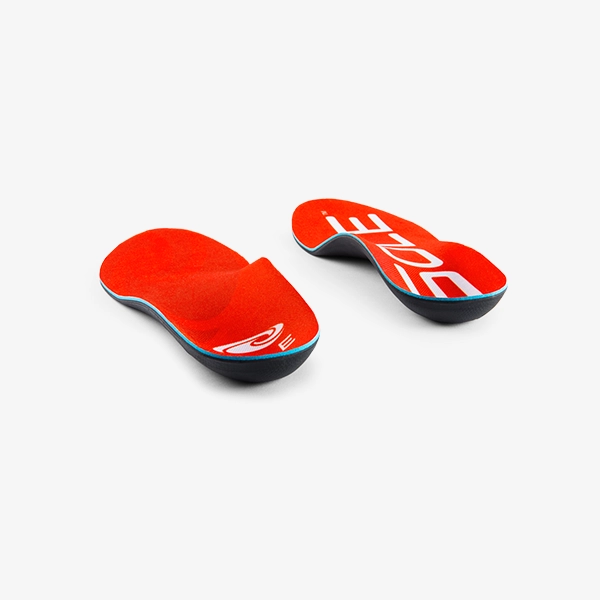
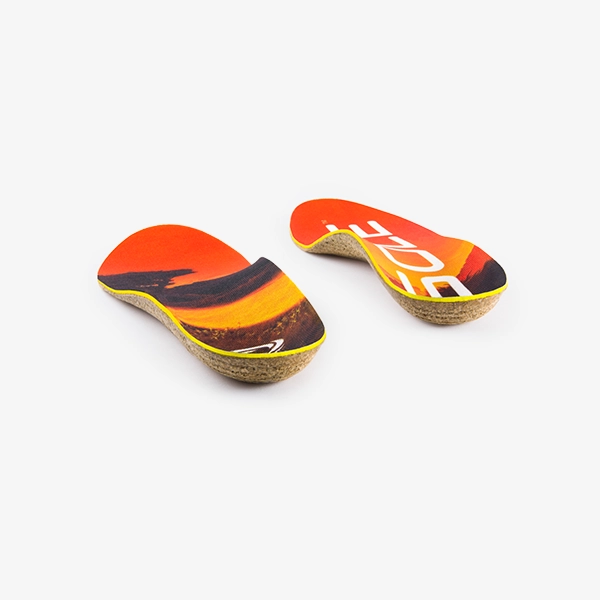
The best insoles for running feature a deep heel cup.
A deep heel cup helps cradle the heel in place, preventing excess lateral movement. It also helps hold the heel’s fatty tissue under the bone, making the most of your body’s natural shock absorption.
When combined, a deep heel cup and good arch support help to promote neutral alignment and stable, efficient movement while you run. With these factors, a running insole can reduce strain on the muscles and ligaments in your feet, but also on your knees, hips and back.
The best running insoles can help prevent shin splints, runner’s knee, achilles tendonitis, peroneal tendonitis, posterior tibial tendonitis and other common ailments experienced by runners.
The best running insoles are zero drop from heel to toe.
The heel-to-toe drop of a running shoe’s midsole is a big consideration for many runners. The best insoles will support your feet within the shoe, while leaving the bottom of your heel and forefoot at the same height (zero drop from heel to forefoot).
By choosing an insole with a zero-drop platform you can add it to your running shoes without impacting the feel of the shoe when it comes to your strike pattern.
A zero-drop insole has no change between the height of the heel and the forefoot.
A zero-drop insole has no change between the height of the heel and the forefoot.
For the best support and fit, choose a custom moldable running insole.
Your feet are unique, and having an insole that custom molds to support them can make a huge difference to the comfort and support you experience. The most important element of custom molding is that a running insole should fit your arch accurately.
With an insole that custom molds to your arch, you have support that hugs your foot evenly and consistently, helping to effectively distribute pressure with each step you take. This custom support amplifies the positive effects of the insole on your alignment, as well as increasing the effectiveness of reducing strain.
When these factors combine, a custom molding insole is overall far more effective at reducing strain and preventing fatigue in your feet, ankles, knees and beyond.
The best running insoles come with a guarantee to protect you.
Let’s face it, what works for one person might not work for the next. Runners are also very particular about the fit and feel of their shoes. For this reason, the best insoles for any runner are insoles that come with a satisfaction guarantee to protect you from losing money if you don’t enjoy wearing them.
Why SOLE footbeds are the best insoles for long-distance runners and casual runners alike.
SOLE footbeds all feature the SOLE Signature Supportive Shape that’s clinically proven to reduce strain in the feet by an average of 34%. They are made with a single, solid base material that has varying densities mapped to provide more supportive structure where you need it, and less rigidity where your foot needs to flex more.
This construction means you don’t have a rigid shank underneath a single layer of foam, which often leads to quick wear and rubbing or blistering against the shank in the forefoot area.
The arch support of SOLE footbeds is also dynamic, flexing with your foot as you take each stride. This means you get strain reduction without controlling the natural energy transfer of your feet. SOLE footbeds also come in a full size range, meaning you get support for your specific shoe size and arch length.
What really sets SOLE running insoles apart is their custom moldable design. All SOLE footbeds can be heat molded to your unique feet in an easy process using your own oven at home. This allows you to enjoy all the benefits of customized comfort in your running shoes, at an affordable cost.
Lastly, SOLE footbeds all come with a 90 day satisfaction guarantee. You can heat mold them, trim them down if needed, give them a thorough trial, and if they don’t work for you, send them back within 90 days of purchase for a refund.
Running insoles with a metatarsal pad.
If you suffer from forefoot ailments like metatarsalgia or Morton’s neuroma, a running insole with a built-in metatarsal pad or ‘Met Pad’ can make a big difference to your comfort while you run.
A Met Pad supports your foot’s transverse arch to optimize the spacing and positioning of your foot’s major bones, the metatarsals. This helps improve circulation and prevent numb and tingling toes too.
SOLE Met Pad footbeds have a metatarsal pad built right into the insole’s structure so you don’t have to worry about the Met Pad moving in your shoe while you run.
Many people enjoy the support of a Met Pad footbed, even without suffering from specific forefoot ailments.
The best insoles for running with flat feet.
Running places especially significant strain on the plantar fascia and other areas of the foot, as well as the ankles and knees, for people with flat feet. This is because with flat feet or collapsed arches, you are lacking the structural elements that absorb shock and ensure neutral alignment.
People with flat feet often also deal with biomechanical inefficiencies like overpronation which places further strain on a range of ligaments and tendons in the lower leg.
The most important thing for flat feet is arch support, to help promote proper alignment and correct any biomechanical inefficiencies you might be dealing with. But arch support can be difficult to adjust to, and can be uncomfortable to begin with.
Custom moldable insoles like SOLE footbeds can help you adjust more quickly to the sensation of added support under your feet. Heat molding the footbeds helps to make the arch support more immediately comfortable for people with flat feet, so you can stick with wearing the insoles and enjoy the benefits they offer while you run.
SOLE footbeds come in 3 thicknesses, with different levels of cushioning.
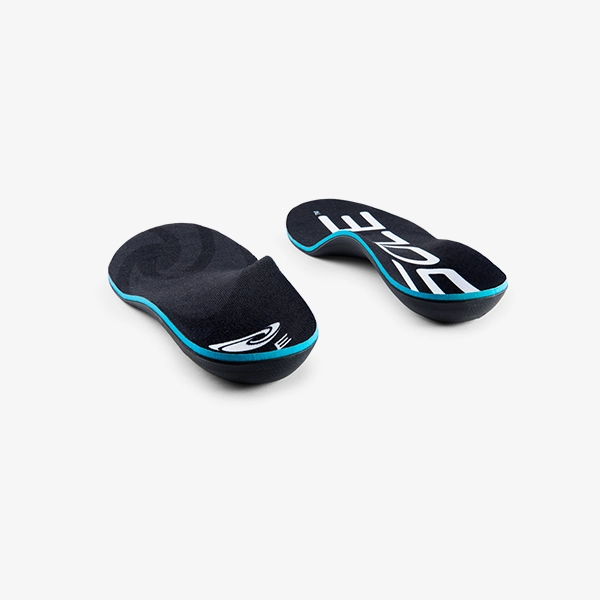
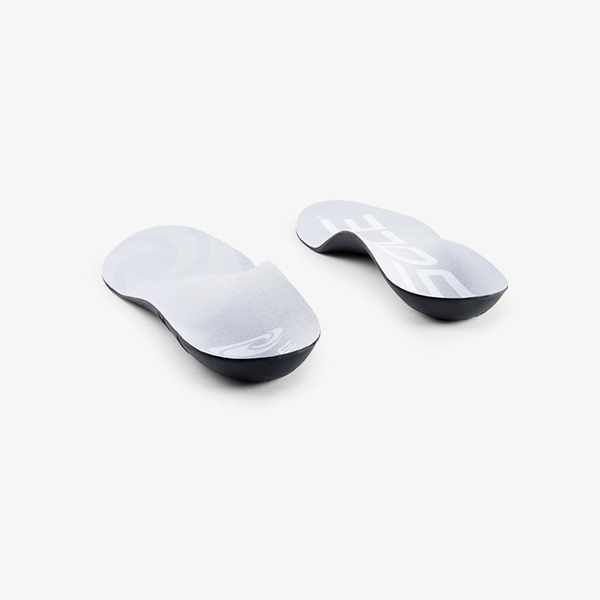
Are gel insoles or foam best for running?
When it comes to absorbing pressure and impact, the best running insoles all have one thing in common: they prioritise supporting your foot’s natural ability to absorb shock. No amount of gel or foam will prevent fatigue and pain if it isn’t combined with proper structural support for your foot’s natural shock absorption.
That’s why the arch support and deep heel cup discussed above are so important. When it comes to gel vs foam, gel can absorb more direct shock and impact more efficiently. But the best insoles for running will utilize a high-quality open-cell foam.
High quality foam cushioning, like the Softec cushioning used in SOLE footbeds, offers a combination of shock absorption, energy-return and pressure distribution. This is especially valuable for people who run long distances.
The best insoles for road running.
SOLE Medium thickness footbeds are the gold standard in running insoles for the road. They have a layer of open-cell cushioning that’s thick enough to absorb impact efficiently, while still being thin enough for a versatile fit in most running insoles.
Choose between Active Medium for the most durable option with the sturdiest support, or Performance Medium for a slightly more springy return, made using recycled natural cork.
The best insoles for running in tight shoes.
If you run in tighter-fitting running shoes, you’re best off going with a Thin footbed. Your choice is between the Active Thin for maximum durability, or the Performance Thin for marginally more shock absorption from its natural cork base.
The best-selling SOLE Active Medium footbeds.
The best-selling SOLE Active Medium footbeds.
The best insoles for trail running.
If you trail run in a dry climate, the same recommendation applies to the road running options suggested above: either Active or Performance Medium.
But if you tend to run on wet days and puddles are an issue, if you’re likely to get soaking wet feet, we recommend you choose the Active Medium footbeds. The EVA plastic of the Active Medium holds up against water slightly better than the natural cork of the Performance Medium.
The best insoles for maximum cushioning.
If you’re looking for the most cushioning possible, consider the SOLE Active Thick or Performance Thick footbed. These options include a luxuriously thick layer of Softec cushioning.
They do take up a significant amount of space in your shoe though, so only go for a Thick footbed if your shoe fits on the looser side and has wiggle room to spare.
If you’re struggling with a specific injury, check out these resources on exactly why SOLE footbeds are the best choice to help with shin splints, achilles tendonitis, peroneal tendonitis, posterior tibial tendonitis, runner’s knee, back pain.